Blog 4: Reflect on the idea that tests are the only objective assessments of student learning.
Tests. We've all taken them. Were you one of the lucky ones that aced every test, or among the countless numbers of students who,no matter how hard they tried, never did well on them? I have seen students who know the material, but fail the test. My son is one of these; he has text anxiety. While I understand the importance of tests, I do not feel they are the only objective assessments of student learning.
Tests have their place in education, but if it is the only means of evaluating student learning, we are cheating our students. A test is great for measuring the retention of facts, but assessments should also reflect the students' authentic knowledge and learning. According to Educational Testing Service (ETS), (2003), the form of assessment a teacher uses should depend on what information is being taught, the purpose of the lesson, and what the teacher wants to learn from the assessment. For example, in a lesson regarding figurative language and its affect on poetry, rather than testing students for retention of information, teachers could have students create their own poem using the content learned.
Tests tend to restrict student responses and may put some students at a disadvantage. The multiple choice and true or false tests can be worded in such a manner as to confuse a student. Students who have given it their all and still perform poorly on these tests, become discouraged and are no longer motivated to learn. A teacher should consider the needs of his or her students and design assessments with those needs in mind.
Students learn in many different ways and should be given the opportunity to demonstrate learning in a manner that allows them to be successful. For example, I am much better at writing an essay than I am at taking a test. It allows me to use my creativity in writing while I exhibit the knowledge I have learned. Performance assessments can be used to assess many different skills at once. They are also easy to integrate into lessons without interrupting the teaching. Speeches, skits, videos, and blogs are just a few of the ways that are easily infused into a lesson and can give an educator great insight into the students’ learning. When educators use authentic assessments, they are providing students with skills that will help them later in life.
While tests are necessary and useful at times, no single test or assessment can accurately measure a student's overall performance. They are simply snapshots of one particular day and one particular instance. Educators should strive to use a variety of assessments regularly to get a more accurate picture into each student's abilities and learning.
References
Educational Testing Service (2003). Linking Classroom Assessment with Student Learning. Retrieved from http://www.ets.org/Media/Tests/TOEFL_Institutional_Testing_Program/ELLM2002.pdf
Teachers and Technology
"There can be infinite uses of the computer and of new age technology, but if teachers themselves are not able to bring it into the classroom and make it work, then it fails.” - Nancy Kassebaum
Wednesday, January 22, 2014
Wednesday, January 08, 2014
The Technology-Infused Classroom
Reflect on the idea of what a technology-infused classroom looks like. How do you plan to have a technology-infused classroom?
When I was high school, back in the 70’s, teachers were the primary source of information. Students were passive vessels eagerly storing the knowledge the teachers dispensed. Today, students are no longer passive. They think and process information differently than my generation. Having grown up with technology as part of their daily lives, they have almost unlimited information at their fingertips. I have heard teachers state that students are no longer connected to their peers, but I tend to disagree. They are almost too connected. Texts, instant messaging, social media, photos, video chats, and online gaming are just a few of the ways students are connecting to their peers and to the outside world. They are no longer interested in sitting still in a classroom listening to lectures. They want and expect to have more control over their learning.
I envision a technology-infused classroom where students are active, creative, inquisitive, and on-task. Rather than leading the learning process, the teacher serves as a facilitator and coach guiding students in their learning. Technology is an integral part of this process, but it requires teachers and students to take a different approach to learning. This is a reciprocal process where students and teachers collaborate to achieve common goals. First, teachers must be willing to take risks and acknowledge that their students may know more about the technology than they do. They should be willing to have students teach them. Second, teachers must invest time in research. Subscribe to educational technology sites, blogs, or magazines to become familiar with different technologies and how they can benefit the classroom. Last, students must buy into their learning. This is accomplished by making learning meaningful to them. The computer is no longer just for essays. If used appropriately it promotes higher learning and real world applications. Project based learning with technology stimulates and challenges students while providing them with experiences that will benefit them far beyond the classroom walls. Working individually, and within a group, to research and analyze a problem provides the higher level thinking skills needed for success in the real-world.
Edutopia's article (2008), Why Integrate Technology into the Classroom: The Reasons Are Many states that
In my classroom, I model and scaffold curricular and technological learning and encourage students to explore and be creative, but it has not been easy. I teach in a charter school and although we have made tremendous strides in purchasing technology, the implementation of it still lags behind. While there are many reasons for the lack of technology integration, I believe one of our biggest obstacles is the lack of training. Our professional development rarely provides the teachers with the knowledge or instruction to begin using technology. When our school received SmartBoards a few years ago, we had a 20 minute discussion on how to orient the board and a brief overview. It did not prepare teachers to utilize its many functions, so in many classrooms it is no more than a glorified whiteboard. Another obstacle that perpetuates teacher reluctance is the lack of a clear model explaining how to integrate the technology into the state curriculum (Morehead & LaBeau, 2005).
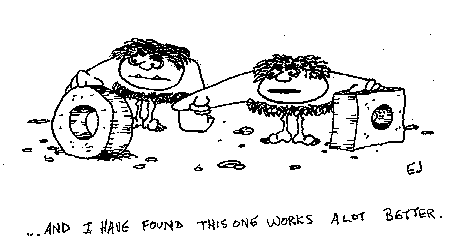
Using technology in the classroom just to say you are using it, does not accomplish anything. Technology must not only aid in meeting the curriculum, objectives, and learning goals for the class, but enhance it as well. It should flow seamlessly as if they were designed to go together, and not as an afterthought. There is no reason for a teacher to reinvent the wheel, however. Teachers can team up and collaborate on technology plans. There are also numerous websites that offer lesson plans, resources, and student activities to help teachers integrate technology into their curriculum.
reprinted with permission by Eric Jacobsen
At the present time, I work with small groups of students who have reading disabilities. Before I started researching technology-infused classrooms,I felt that I was doing an adequate job in using technology. I incorporate the SmartBoard, document camera, computers, and Kindles into my lessons. My students blog and make book trailers to extend their knowledge of reading, but I realize there is room for improvement. I would like to improve my teacher website by making it more interactive and incorporating resources for students and parents. I am always on the alert for new ideas and I never know where I may find them. I have found many useful blogs and I have recently subscribed to edtechteacher and Free Technology for Teachers. Educational technology is constantly changing and I intend to change along with it.
References
Edutopia. (2003, April 1). A commitment to high tech education. Retrieved from http://www.edutopia.org/harrison-high-school-technology-integration-video
Edutopia. (2008, March 16). Why integrate technology into the classroom? the reasons are many. Retrieved from http://www.edutopia.org/technology-integration-introduction
Jacobsen, E. (2002, February 02). Eric Jacobsen's cartoon page. Retrieved from http://www.ericjacobsen.org/toons.htm
Morehead, P. & LaBeau, B. (2005, September 28). The continuing challenges of technology integration for teachers. Retrieved from http://www.usca.edu/essays/vol152005/moreheadrev.pdf
When I was high school, back in the 70’s, teachers were the primary source of information. Students were passive vessels eagerly storing the knowledge the teachers dispensed. Today, students are no longer passive. They think and process information differently than my generation. Having grown up with technology as part of their daily lives, they have almost unlimited information at their fingertips. I have heard teachers state that students are no longer connected to their peers, but I tend to disagree. They are almost too connected. Texts, instant messaging, social media, photos, video chats, and online gaming are just a few of the ways students are connecting to their peers and to the outside world. They are no longer interested in sitting still in a classroom listening to lectures. They want and expect to have more control over their learning.
I envision a technology-infused classroom where students are active, creative, inquisitive, and on-task. Rather than leading the learning process, the teacher serves as a facilitator and coach guiding students in their learning. Technology is an integral part of this process, but it requires teachers and students to take a different approach to learning. This is a reciprocal process where students and teachers collaborate to achieve common goals. First, teachers must be willing to take risks and acknowledge that their students may know more about the technology than they do. They should be willing to have students teach them. Second, teachers must invest time in research. Subscribe to educational technology sites, blogs, or magazines to become familiar with different technologies and how they can benefit the classroom. Last, students must buy into their learning. This is accomplished by making learning meaningful to them. The computer is no longer just for essays. If used appropriately it promotes higher learning and real world applications. Project based learning with technology stimulates and challenges students while providing them with experiences that will benefit them far beyond the classroom walls. Working individually, and within a group, to research and analyze a problem provides the higher level thinking skills needed for success in the real-world.
Edutopia's article (2008), Why Integrate Technology into the Classroom: The Reasons Are Many states that
Effective tech integration must happen across the curriculum in ways that research shows deepen and enhance the learning process. In particular, it must support four key components of learning: active engagement, participation in groups, frequent interaction and feedback, and connection to real-world experts. Effective technology integration is achieved when the use of technology is routine and transparent and when technology supports curricular goals.When administration understands the importance of technology and supports the faculty in the inclusion and integration of technology remarkable things can happen. To see how one high school in Mississippi has learned to integrate technology across the curriculum watch this video from Edutopia (2003).
In my classroom, I model and scaffold curricular and technological learning and encourage students to explore and be creative, but it has not been easy. I teach in a charter school and although we have made tremendous strides in purchasing technology, the implementation of it still lags behind. While there are many reasons for the lack of technology integration, I believe one of our biggest obstacles is the lack of training. Our professional development rarely provides the teachers with the knowledge or instruction to begin using technology. When our school received SmartBoards a few years ago, we had a 20 minute discussion on how to orient the board and a brief overview. It did not prepare teachers to utilize its many functions, so in many classrooms it is no more than a glorified whiteboard. Another obstacle that perpetuates teacher reluctance is the lack of a clear model explaining how to integrate the technology into the state curriculum (Morehead & LaBeau, 2005).
Using technology in the classroom just to say you are using it, does not accomplish anything. Technology must not only aid in meeting the curriculum, objectives, and learning goals for the class, but enhance it as well. It should flow seamlessly as if they were designed to go together, and not as an afterthought. There is no reason for a teacher to reinvent the wheel, however. Teachers can team up and collaborate on technology plans. There are also numerous websites that offer lesson plans, resources, and student activities to help teachers integrate technology into their curriculum.
At the present time, I work with small groups of students who have reading disabilities. Before I started researching technology-infused classrooms,I felt that I was doing an adequate job in using technology. I incorporate the SmartBoard, document camera, computers, and Kindles into my lessons. My students blog and make book trailers to extend their knowledge of reading, but I realize there is room for improvement. I would like to improve my teacher website by making it more interactive and incorporating resources for students and parents. I am always on the alert for new ideas and I never know where I may find them. I have found many useful blogs and I have recently subscribed to edtechteacher and Free Technology for Teachers. Educational technology is constantly changing and I intend to change along with it.
References
Edutopia. (2003, April 1). A commitment to high tech education. Retrieved from http://www.edutopia.org/harrison-high-school-technology-integration-video
Edutopia. (2008, March 16). Why integrate technology into the classroom? the reasons are many. Retrieved from http://www.edutopia.org/technology-integration-introduction
Jacobsen, E. (2002, February 02). Eric Jacobsen's cartoon page. Retrieved from http://www.ericjacobsen.org/toons.htm
Morehead, P. & LaBeau, B. (2005, September 28). The continuing challenges of technology integration for teachers. Retrieved from http://www.usca.edu/essays/vol152005/moreheadrev.pdf
Subscribe to:
Posts (Atom)